Protecting the Rights of International Researchers
International scholars have always faced particular challenges on account of our status as visa holders. Our precarious position is just one of the many sources of stress we experience as postdoctoral researchers and research associates working at CHOP. By forming unions across the country, international scholars have secured many protections and benefits previously unavailable to us, resulting in a safer and more secure environment for our work.
Postdocs at the University of California won stronger rights for international postdocs in their contract by ending UC’s practice of denying full health benefits for many international postdocs and ensuring equal treatment regardless of immigration status. Postdocs at Columbia University won increased job stability for international workers. Their contract guarantees that appointments must be held open for at least 60 days if work authorization is delayed, that postdocs must receive paid time off for immigration-related proceedings, and that academic workers must be given greater flexibility to work remotely if unable to return to the U.S. Postdocs at Mount Sinai who unionized won reimbursements of up to $1,250 for visa stamp renewal related travel and fees.
International postdocs and researchers have the same federally protected rights to unionize as U.S. citizens. This means that signing a union authorization card will not jeopardize or delay application for legal permanent residence. Union authorization cards are submitted to the U.S. National Labor Relations Board, which is the independent third-party federal authority that verifies support and oversees the unionization process, and are not released to your supervisor, the CHOP administration, or other government agencies. Tens of thousands of international postdoctoral researchers and other academic workers have signed union authorization cards and openly participated in union activity around the country. There have been no reported instances of visa or green card applications getting delayed or rejected as a result of signing an authorization card or otherwise participating in a unionization effort.
Nationally, the UAW represents more than 140,000 workers in higher education, a powerful force for effective lobbying, particularly on issues that affect international scholars and researchers. Over the past two years, UAW academic workers have organized multiple efforts to defend international researchers and scholars from immigration-related attacks. Unionized higher education workers have created support resources for international members, including a free hotline staffed by immigration attorneys, FAQs, and know-your-rights webinars, and have won new institutional protections such as a legal support fund at the University of California. UAW academic workers have also backed major legal challenges to government policies targeting non-citizen academics, supporting litigation against the Trump administration’s policy of arresting or deporting scholars for protected speech in the case American Association of University Professors v. Rubio, which argued that deporting students and faculty for their political expression violated constitutional protections. In addition, they’ve filed amicus briefs in cases such as Svitlana Doe v. Noem challenging the termination of the TCHNV parole program that allowed certain immigrants from Cuba, Haiti, Nicaragua, and Venezuela to live and work lawfully in the United States. Beyond the courts, UAW academic workers have lobbied Congress to expand visa and green-card access and to oppose policies targeting Chinese students and scholars.
UAW academic workers have also used their collective strength to write thousands of letters to elected officials, protest outside of ICE offices, share immigration stories with the press, host information sessions with immigration attorneys, and submit formal declarations filed in lawsuits to overturn xenophobic policies. Working with members of Congress, UAW academic workers helped win the Optional Practical Training STEM extension, an important path for international student workers to work in the US after completion of their PhD. UAW unions representing postdocs and student workers in Washington State and California also worked with Congressional representatives Judy Chu and Pramila Jayapal on a Dear Colleague letter demanding that then-Secretary of State Pompeo restore the validity period of Chinese international students’ entry visas from 12 months back to 60 months.
UAW members have a strong history of effective lobbying for the rights of international academic workers. At a time when political attacks against higher education, publicly funded research, and international workers are increasing, it is more important than ever to join hundreds of thousands of other academic workers as we fight to protect our interests and livelihoods.
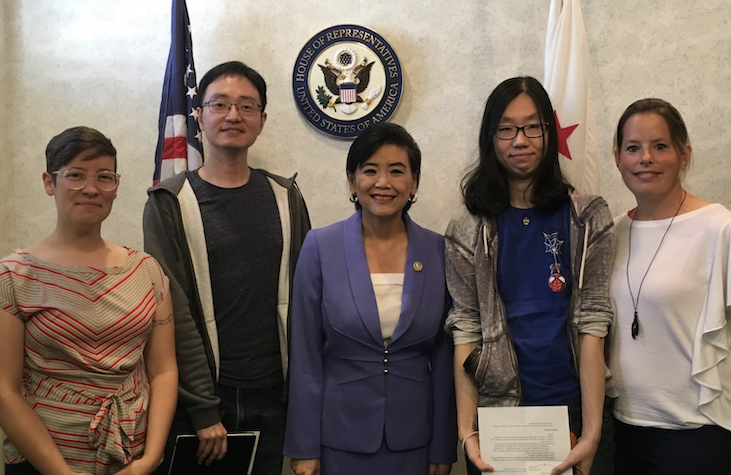
UAW Local 2865 and UAW 5810 union members with Congresswoman Judy Chu discussing her Dear Colleague Letter in support of Chinese international students at her office in Pasadena, 2018.